Thank you for choosing a Calore wood-burning fireplace. Designed for efficiency, safety, and durability, your fireplace will deliver optimal performance when installed, operated, and maintained in accordance with these guidelines.
GENERAL USER GUIDELINES
CALORE WOOD BURNING FIREPLACES
IMPORTANT OPERATING PRINCIPLES
To ensure optimal performance and protect your investment, the following principles must be observed:
- Ensure installation is completed correctly and in full accordance with all requirements
- Burn only dry, well-seasoned wood
- Perform a commissioning (break-in) fire before regular use
- Do not over-fire the appliance
- Schedule annual servicing with a qualified Calore-approved service technician
Failure to follow these guidelines may result in reduced performance, damage to the appliance, and may void the warranty.
COMMISSIONING FIRE (INITIAL BREAK-IN)
A break in fire is essential for the following reasons:
- Preventing damage: Allows the body of the fireplace to expand and contract gradually, reducing the risk of thermal shock and cracking
- Curing the paint: Enables high-temperature paint to cure properly without excessive odour or flaking
- Sealing components: Allows fire cement used during installation to dry and set correctly
- Flue preparation: Helps remove residual moisture and establish initial draw
Procedure:
- Light a very small fire using only kindling
- Allow the unit to reach operating temperature for approximately one hour
- Allow the fireplace to cool completely to room temperature
- Repeat this process two to three times, gradually increasing the fire size and temperature
- Ensure adequate ventilation by opening doors and windows during initial fires to allow curing fumes to dissipate
FUEL REQUIREMENTS – USE DRY, SEASONED WOOD
For optimal performance, only dry, seasoned wood must be used. Blue Gum and Black Wattle are ideal for daily use, offering a balanced burn rate and consistent heat output. Seasoned wood is timber that has been cut and dried for at least 12 – 24 months, ideally stored under cover. It should have a moisture content below 18%. Properly seasoned wood is lighter in weight, often shows cracking at the ends, and may have loose or peeling bark.
Burning unseasoned (wet) wood will:
- Reduce combustion temperature
- Decrease heat output
- Increase in smoke and emissions
- Promote creosote build-up
- Accelerate internal corrosion
Benefits of dry, seasoned wood:
- Easier ignition
- Cleaner combustion
- Maximum heat output
- Extended appliance lifespan
Do not burn:
- Coal or anthracite
- Treated or painted wood
- Household waste or plastics
STARTING YOUR FIRE
Ensure the ash pan is empty, the glass is clean, and all air controls are fully open.
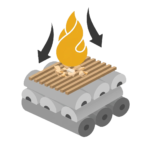
Recommended Method: Upside-Down Fire:
Step 1 – Base Layer (Large Logs). Place the largest logs tightly together at the bottom.
Step 2 – Intermediate Layer (Medium Logs). Add medium-sized logs on top of the base layer.
Step 3 – Top Layer (Kindling & Firelighters). Place kindling and firelighters on the top layer.
Step 4 – Ignition Light the firelighters. The fire will burn from the top down, creating a progressive ignition effect.
This method:
- Improves combustion efficiency
- Reduces smoke
- Minimizes creosote build-up
- Produces a longer, cleaner burn

OPERATING YOUR FIREPLACE
For consistent performance:
- Load the fireplace approximately once per hour rather than adding small amounts continuously
- When only embers remain:
- Spread the coals evenly
- Add new logs
- Adjust airflow once the fire is established
Heat output is regulated by fuel load and airflow. When heating a cold space, use a larger initial load. Reduce the load once the desired temperature is reached.
AIR CONTROL MANAGEMENT
Calore fireplaces may be fitted with one or two air controls.
- Start-up: Fully open all air controls
- Normal operation: Reduce airflow once the fire is established
- Reloading: Open airflow before adding wood, then reduce once stable
For fireplaces with both primary and secondary air controls:
- Start with both controls fully open
- Once the fire is well established, close the primary air
- Use only the secondary air control for regulation
Leaving both controls fully open during operation may cause over-firing and damage the appliance.
FIREWOOD LOAD GUIDELINE (PER HOUR)
Indicative heat output using dry, seasoned wood:
- 2 logs → ±6 kW
- 3 logs → ±9 kW
- 4 logs → ±12 kW
- 5 logs → ±15 kW
- 6 logs → ±18 kW
- 7 logs → ±21 kW
- 8 logs → ±24 kW
Notes:
- Outputs are approximate and may vary
- Overloading reduces efficiency and increases emissions
- Always operate within recommended limits
CERAMIC INTERNALS (WHERE APPLICABLE)
Select models feature vermiculite / ceramic lined combustion chambers designed to:
- Increase internal temperature
- Improve combustion efficiency
- Maintain cleaner glass
Handle with care. Do not drop logs into the firebox. Minor surface cracks are normal and do not affect performance. Damaged panels must be replaced.
FANS (WHERE APPLICABLE)
- Operate automatically via thermostat
- Activate once operating temperature is reached (approximately 40 minutes)
- Switch off automatically as the unit cools
Manual controls allow adjustment between operation and control airflow.
GLASS CARE
The glass door is designed to withstand high temperatures but requires proper care.
To maintain clarity:
- Use dry, seasoned wood
- Clean regularly with a suitable fireplace glass cleaner (available from Calore)
- Avoid impact or sudden temperature change
Do not operate the fireplace if the glass is cracked.
FIREPLACE METALS
Some internal oxidation is normal due to high temperatures.
Excessive rust may indicate:
- Moisture ingress through the flue
- Use of wet wood
External corrosion may occur in coastal or high-humidity environments. Protective products may be used to maintain finishes.
SERVICING
Annual service is required to ensure safe and efficient operation.
A qualified technician will:
- Inspect the fireplace and flue system
- Check for wear or damage
- Apply protective treatments where required
IMPORTANT NOTICE
For optimal performance and to maintain warranty validity, these guidelines must be always followed. Improper use, incorrect fuel, or inadequate maintenance may result in damage to the appliance and may void the warranty.